Volkswagen has announced that it is planning to stop production of its Beetle once again, although there is no specific timeline as of when. However, the Beetle is certainly no ready to disappear off the production line yet. Customization experts Memminger is known for its restorations of the Volkswagen Beetle since the mid-‘90s. It just released its own custom concept of Memminger Roadster 2.7, named after the liter size of the air-cooled boxer engine.
Bespoke Carmaker Memminger makes a Better Beetle than Volkswagen
Visually, there are several radical enhancements to the Memminger Roadster compared to the iconic bug. The cute classic Beetle is reimagined into a two-seat roadster sporting a low, wide body with pumped up fenders.
The chassis is replaced with an all tube-frame, semi-visible in the interior, while the seats are covered with a vintage plaid. Tires are much bigger huge, 225-mm wide, and 255-mm up front and wide in the back, they’re mounted on 18-inch wheels.
One of the most notable change to the car is its engine. The Memminger Roadster upgrades the original 1.6-liter flat-four to a 2.7-liter engine, good for 210hp and 182lbft of torque. Memminger claims that it is based on the same engine in the VW Type 4 and Porsche 914. The traditional rear-mount is also shifted to a mid-mount to provide a better balance to the car.
Availability is yet confirmed but production run is said to be just 20 worldwide. Learn more about the car on Memminger.
Renowned 1960s British vessel, Queen Elizabeth 2, has been docked in Port Rashid since 2008 after decades of voyage. Last Wednesday, it opens her doors yet again as a brand new, luxury hotel floating in Port Rashid, Dubai. Though there were plans to remodel the ship into a luxury property immediately, delayed the project was delayed by the global financial crisis. Finally after a decade, the 963-foot cruise liner will welcome guests again.
The hotel holds a full 13-deck of dining and entertainment, and a total of 224 rooms and suites. There are 13 types of room available, with the basic cabins offering a cozy 180 square feet of space, designed with plenty of dark wood.
A duplex room at the Queen Elizabeth 2
Royal suites sit at a spacious 800 square feet, complete with a private bathtub, private dining room and terrace. Named after the Queen’s mother and grandmother, these 2 exclusive rooms will be booked ‘by invitation only’.
Rooms featuring the original portholes abroad the hotel.
While the liner has been upgraded with technology and modern features, there were also restoration efforts for the original design features like the portholes and period artwork and furniture.
The ship even retains the names of its 13 restaurants for a distinct British feel: an English pub called the Golden Lion, historical bar The Chart Room, cabaret lounge The Grand Lounge, and Queens Grill that offers a British menu that includes many of the same dishes served during its maiden voyage in 1969.
A refurbished bar is ready to receive guests aboard the Queen Elizabeth 2
The new QE2 has a movie theatre and a museum showcasing the vessel’s history. The latter, called the Heritage Exhibition, presents the ship’s iconic history that traces back to decades ago since its service as a war ship during the Falklands War, to when she became Cunard’s luxury leisure cruise ship.
Other facilities include a luxury spa and pool deck, as well as the perennial Dubai favorite: a shopping arcade.
The grand opening is scheduled for October this year. Right now, you can book a basic cabin online for as low as 400 AED (US$110), though royal suites sell for as much as 25,000 AED (US$6,800).
Founded in 2006 by Tuan Andrew Nguyen, Phunam and Matt Lucero, The Propeller Group is an art collective based in Ho Chi Minh who makes large-scale, collaborative projects. From visionary works that re-brand the nation to interventions at artist villages, their work in the past twelve years has breached the extensive international network of cultural production to considerable success.
It is thus not surprising that they have been featured and commissioned to exhibit in internationally renowned museums and festivals. Amongst these include the Guggenheim Museum (2011 – 2012), San Francisco Museum of Modern Art (2012), Los Angeles Biennial (2012), and the 56th Venice Biennale (2015). Their current shows span across two distant continents: a solo exhibition at the San Jose Museum of Art and a group exhibition as part of ‘Cinerama: Art and the Moving Image in Southeast Asia” in the Singapore Art Museum, both on show till March 2018.
The Propeller Group, ‘Temporary Public Gallery’, 2010, public billboard.
What makes their works particularly intriguing is how they are borne out of paradoxes. Simultaneously provocative and subtle, their works seek to challenge prevailing ideological systems by adopting the language of the institutions that dominate the production of culture and economy. Confronting their aversion towards the medium of advertising, they wield its strategies to reach the mass consciousness in ways that traditional art forms cannot.
At the heart of this complex maneuvering lies the simple trajectory towards free communication of art. Here, art and pedestrian life are not mutually exclusive forms to be experienced, and the public space is the art space.
ART REPUBLIK speaks with the collective to learn more about how mass media and their collaborative efforts both drive their work, and projects audiences can expect from them in the near future.
The Propeller Group, ‘Television Commercial for Communism’ (video still), 2011, 5 channel synchronised video installation with 1 channel video, 2048 x 1152, video duration 60 secs.
What are the origins of the collective?
There are actually multiple origins to the collective, but the point in the narrative where the different trajectories collide and where different elements begin to concretise to create the collective happened around 2006. Two artists, Phunam and Tuan, who would later be members of the group, were shooting a documentary film about the first generation of graffiti artists in Vietnam. They were quickly made to realise that it was illegal to film in public without permission. After some research they discovered that the only way to get proper licensing was to either go through a governmental organisation, which as one can imagine would be extremely tedious and difficult, or the other option would be to go through a commercial film production company.
The most obvious choice then, was to register as a legitimate “film production company”. Shortly after the registration process was initiated, we, who were now several artists who had background working in different mediums, quickly discovered that to register as an “advertising company” would give us more access to public space than just being able to ask for permission to film in public. For instance, advertisers would be able to rent advertising space in public, organise large-scale public events, buy media on television and radio etc. This was at a time when large global advertising agencies were coming into the country following and serving large product brands. The country was giving benefits to advertisers for that reason. We jumped on the bandwagon. So the group, who had always had a bit of enmity towards advertisers, became an advertising company.
Why the name ‘The Propeller Group’?
When it came to the point to fill out the forms for starting an advertising company, we realised that we had not considered the most important part of an advertising company: brand identity.
So in the midst of our confusion combined with being caught off-guard, the most obvious thing to do was to ask the internet gods. We typed in a few key words, like “art collective”, “advertising”, “public art”, “public relations”, “film production”, “branding”, “marketing”, “propaganda” etc. and the company name that kept coming up was “The Propeller Group”. There were film production companies, advertising companies, PR firms, marketing groups, and even an art collective in the 70s called The Propeller Group. We felt that there was a sort of magic in being able to take part in the continuation of this “brand”. The magic maybe was part and partial in the ability to camouflage ourselves, especially while working in a context like Vietnam, in this lineage known as “The Propeller Group” that has moved through time and space.
El Mac in collaboration with The Propeller Group, ‘Light in Little India’, 2010, in Viet Nam the World Tour.
You have mentioned that the group will be transiting from one with fixed membership to one with a more fluid platform. How might this possibly impact the idea of The Propeller Group as a “brand”?
Actually, the collective was always imagined as an organic structure for which multiple collaborative practices could attach themselves to and was hence designed as a malleable structure with revolving membership. An organism of collaboration so to speak. We looked at different models of collective production and collectivity ranging from other art collectives past and present, film crew structures, graffiti art crews, ad agencies etc. A group that is attached to specific membership has a higher chance of reaching an end point.
At the same time, the intention to participate in a collective was to be able to operate anonymously, to be able to think beyond our own “individual” branding. This also allowed us a space in which the idea and nature of “branding” could be put into question, challenged, taken apart, built back up and maybe re-invented. If we are lucky, and these ideas of collectivity and branding work in the way we imagined, The Propeller Group will last over a hundred years and would have benefited from the participation of hundreds of artists and cultural producers.
The members of your collective also work independently, for example with Tuan’s current solo exhibition, ‘Empty Forest’, which runs presently at The Factory Contemporary Arts Centre in Vietnam. Tell us more about how the collective has served as a conceptual platform or has influenced your individual work.
Each member, past and present have always had a practice outside of the collective. We believe that a collective should benefit the individuals working within the collective as much as the individual should benefit the collective, which is also to say that one member should be able to help the other members of the group in their own artistic growth. The transfer of ideas and resources and energies within this network should be a symbiotic relationship. The roundtable in the collective becomes the plate onto which everyone contributes ideas. That contribution of ideas is a process that affects each individual that has come to that roundtable.
Every idea thrown onto that table then belongs to the collective, but there’s no doubt that each individual sitting at that table has learned something new in that process. That might be with regards to information and knowledge, but it might also be a new way of seeing things that was catalysed in the process of brainstorming with a group.
The Propeller Group, ‘Monumental Bling: Lenin East Berlin on Lenin Volgograd’, 2013, composite with gold-plating.
Your collective has successfully created many large-scale projects over the years, while inviting a myriad of other collaborators to work with you. Why large-scale works? Is it because the direction of your work requires more accessibility to the public gaze, or is it a resulting culmination of the complex and extensive ideas that go into your projects?
The obvious advantage of working in a collective setting is that a collective practice can be scaled up quite easily simply because a number of different individuals can bring unique skill sets to the table. The conceptual ambition of the ideas must be scaled up as well. We believe this is inherent in the desire to want to work collectively; otherwise one can remain a solo artist and make studio work.
Many of us grew up immersed in graffiti culture and perhaps the idea of uniting individual muralists to make larger “productions” has influenced how we’ve thought as an art collective approaching conceptual work. It was also a feeling that at that specific time in that very specific context— this being Saigon in the mid-2000’s— we found the idea of the “public” and formations of “media space” were very complex spaces that contained the potential to allow us to see things differently. After all, we formed out of a need to address the public space and media. The results of our reaction to form an advertising agency, whether it was a fully conscious decision at the time, were an important aspect of our conceptual trajectory. It was part of the practice.
Your art tends to be quite provocative in nature, from highlighting the paradoxical nature of a Communist country with capitalist inclinations in ‘TVCC’ (2011), to testing the boundaries of public spaces by means of public intervention in ‘Temporary Public Gallery’ (2010). Were there any struggles or difficulties in the process of executing these projects?
Any project worth producing will be a difficult project to realise. Convincing people of what we believe to be a significant conceptual project has always been the most difficult part of any project. Our process tends to bring in people from various other practices that do not necessarily think about form and function the same way we do. So getting our heads to think in similar wavelengths has always been the biggest challenge in realizing any project.
The Propeller Group, ‘The Living Need Light, The Dead Need Music’ (video still), 2014, 3840 x 2160, 21:15mins.
A dedication to creating social and political awareness, especially in Vietnam, seems to be the key trajectory of your collective’s works, particularly in ‘Viet Nam the World Tour’ (2010) and the graffiti-based projects, such as ‘Spray it, Don’t say it’ (2006). What kind of public response and conversation does your work normally incite?
This has always been the most difficult question to answer. We have never really been able to get a grasp on the public response to our work. Maybe we can begin by saying that our inclination to raise awareness was never targeted only towards a Vietnamese audience. The group rarely exhibits in Vietnam.
It appears that most of your works, such as ‘TVCC’ (2012) and ‘Viet Nam the World Tour’ (2010) also have a specific focus in critiquing advertising and branding by adopting the same mass communication platforms utilised by said advertising agents. How has that helped you in critically examining national cultural production?
There is a way that advertising and its methodologies, strategies, and ability to permeate and intrude into the public psyche en masse as well as at the individual level that perplexes and disgusts us. The development of advertising and the evolution of communism actually have many moments of overlap. Propaganda and its strategies like agitprop, have given way to modern advertising strategies. All of this to say that the production, or possibly even the fabrication, of a national identity, appropriates greatly from advertising and agitprop. Political figures as well as governments hire influential advertisers to create their image. National cultural production is based on these very same principles. Those mass communication platforms that you mention are now largely controlled by big and powerful companies looking to increase profit. The political message is a message that was designed to profit somebody who is probably already extremely wealthy.
The Propeller Group, ‘The Living Need Light, The Dead Need Music’ (video still), 2014, 3840 x 2160, 21:15mins.
As a contrast to the focus on advertising and image in some of your works, your recent films, ‘The Living Need Light, The Dead Need Music’ (2014) and ‘The Guerrillas of Cu Chi’ (2012) seem to traverse both the spheres of documentation and intervention. Is there perhaps an archival and documentation aspect to your work as well?
We would like to believe that most of our projects have an underlying element of intervention. Intervention into our understanding of the archive and the document is a form of reflection we often implement in our works.
‘The Living Need Light’ was an exploration and an homage not only to the labourers that make a living helping families celebrate life at the moment of death, but also to the transvestite and transgender communities that use that particular “public space” that opens up during the traditional funeral ceremony as a means of expression and resistance. We felt that the film, something that could be seen as “document” had to intervene upon itself. As such, we worked alongside the performers to create moments that challenged its form as a documentary, to bring in elements that leaned towards the fictitious and the super-real to keep this film operating within the space of resistance. That is to say that it must resist being either read as purely a document or purely as fiction. It must exist in a similar liminal space that the characters in the film exist in.
The Propeller Group, ‘Static Friction: Burning Rubber’ (video stills), 2012, single channel video, 1920 x 1080, 3:46mins (looped).
How do you think the discourses and critiques present in your works might help in illuminating the rest of the contemporary Southeast Asian art scene?
It is a leap for us to think that we might have a hand in illuminating the rest of the contemporary art scene in Southeast Asia. That sounds like quite a humongous task. At the very most, we might have captured a global audience’s attention towards a very, very small part of Southeast Asia, namely Vietnam.
What is in the pipeline for the collective in 2018 and beyond?
We are finishing off an almost two-year-long travelling survey exhibition of our work in the U.S. The exhibition began at the Museum of Contemporary Art Chicago and will be wrapping up at the San Jose Museum of Art in California in the spring of 2018 with a big celebration of a large public mural project made with a long-time collaborator named El Mac. We are also working to finish a film installation that we shot years ago.
Since its debut, the Patek Philippe Nautilus has been a time only watch with a choice of two or three hands, over its history, it’s since added a power reserve, annual calendar and even a revolutionary new mono-dial chronograph. The Baselworld 2018 Patek Philippe 5740/1G_001_DET is a high complication perpetual calendar, the first in the collection.
First introduced in 1976, the Patek Philippe Nautilus Ref. 3700, birthed from the fertile imagination of Gerald Genta, stands as a pioneer of luxury steel watches in the vein of his other creation, the Royal Oak. Watches like the Nautilus 3700 were also notable for one other quality, they were unexpected mechanical bulwarks against the encroaching, industry- disrupting technology known as Quartz. Quartz was cheaper, more precise and as new fangled tech, promoted as being the trendiest thing in watchmaking. After establishing a peerless reputation for classically elegant, gold and platinum dress watches, the Patek Philippe Nautilus (and later the Aquanaut), would soon establish the brand’s domain in sports elegance. In introducing a stainless steel watch with integrated bracelet, the Ref. 3700 Nautilus was a bold move in a brand known for conservative designs. Nevertheless, the Patek Philippe Nautilus would soon put the brand on the path of luxury steel sports watches but home to time only, annual calendar and chronograph editions, the Patek Philippe Nautilus never possessed a grand complication in the collection. That is until Baselworld 2018.
Baselworld 2018 Ref. 5740 Patek Philippe Nautilus perpetual calendar
Patek Philippe Nautilus perpetual calendar 5740 : First high complication in the Nautilus collection
Since its debut, the Patek Philippe Nautilus has been a time only watch with a choice of two or three hands, at times, with a date complication even. This changed 22 years later when Patek Philippe introduced a Nautilus with Indication de Zone de Remontage or IZR (power reserve indicator) in a jumbo 42mm case. The 1998 ref. 3710 can be considered the first time the collection as ever had a complication (not counting the date) of any kind. While it was discontinued after 8 years, in 2005, Patek Philippe re-introduced the concept of complications to the Nautilus collection, this time a Patek Philippe Nautilus 3712 with time, date, moonphases, power reserve & subsidiary seconds in an interesting asymmetric layout. In 2006, one year after the introduction of a complication Nautilus model, Patek Philippe updated the collection with the 5712 (update of the 3712) and a introduced a revolutionary new mono-dial chronograph model, the Nautilus Ref. 5980. By 2010, Patek Philippe introduced another complication into the collection, the Nautilus Annual Calendar 5726.
The moonphase complication first appeared in the Patek Philippe Nautilus 3712The Patek Philippe Nautilus perpetual calendar 5740 is driven by the famed ultra-thin self-winding caliber 240 movement with recessed 22K gold mini-rotor
For Baselworld 2018, Patek Philippe presents the first high complication in the Nautilus line with something of a brand signature – a superlative perpetual calendar, one of the manufacture’s most coveted classics. The Ref. 5740 Patek Philippe Nautilus perpetual calendar carries a noble countenance with the discreet elegance of an 18K white-gold case and the utility of a celebrated expression of high horology, a perpetual calendar that automatically recognizes the number of days in each month, including the periodically recurring 29th of February.
The Patek Philippe Nautilus perpetual calendar 5740 is driven by the famed ultra-thin self-winding caliber 240 movement with recessed 22K gold mini-rotor, further embellished with a thin perpetual calendar module, all ensconced with a 8.32 mm high case with 60 metres water resistance. As a result, the Baselworld 2018 Ref. 5740 Patek Philippe Nautilus perpetual calendar is in fact, it is Patek Philippe’s thinnest perpetual calendar. The architecture of the movement and its refined finissage, including the bridges with chamfered and polished edges as well as the Calatrava cross engraving on the winding rotor, can be admired through the sapphire-crystal display back.
The Patek Philippe Nautilus perpetual calendar 5740 carries a noble countenance with the discreet elegance of an 18K white-gold case and the utility of a celebrated expression of high horology, a perpetual calendarThe three subsidiary dials of the Ref. 5740 Patek Philippe Nautilus perpetual calendar with analog displays (day of the week and 24-hour dial at 9 o’clock, month and leap- year cycle at 3 o’clock, date and moon phases at 6 o’clock) are harmoniously integrated in the subtly rounded octagon of the dial.
The iconic design of the bezel is emphasized by vertically satin finished surfaces that contrast against polished chamfers. The dial of the Patek Philippe Nautilus perpetual calendar 5740 is decorated with the unmistakable raised horizontal embossing while continuing the same sunburst blue decoration that graced the 40th anniversary versions of the Nautilus in 2016. The three subsidiary dials of the Ref. 5740 Patek Philippe Nautilus perpetual calendar with analog displays (day of the week and 24-hour dial at 9 o’clock, month and leap- year cycle at 3 o’clock, date and moon phases at 6 o’clock) are harmoniously integrated in the subtly rounded octagon of the dial. The 24-hour display simplifies calendar settings. The moon-phase display is extremely precise. It is controlled by a mechanism that deviates from the actual position of the moon by merely one day every 122 years.
The correctors of the Patek Philippe Nautilus perpetual calendar 5740 (day correction at 9 o’clock, date correction between 11 and 12 o’clock, month correction between 12 and 1 o’clock, moon-phase correction at 6 o’clock) were optimally positioned with an ingenious system of deflection mechanisms and seamlessly integrated in the Nautilus case design. But even the innovation doesn’t just stop at the calibre but also the white-gold bracelet with a totally new, patented fold-over clasp featuring four independent catches to optimize opening and closing and to prevent the unintended release of either of the two clasp segments.
Patek Philippe, 5740/1G_001_DETThe innovation of the Patek Philippe, 5740/1G_001 doesn’t just stop at the calibre but also the white-gold bracelet with a totally new, patented fold-over clasp featuring four independent catches to optimize opening and closing and to prevent the unintended release of either of the two clasp segments.
Ref. 5740 Patek Philippe Nautilus perpetual calendar Price and Specs
Movement Automatic Caliber 240 Q with 48 hours power reserve Case 40 mm 18k white gold case with 60 metres water resistance Strap 18K white gold with new, patented Nautilus fold-over clasp Price SG$156,800
There are strong signs of what could potentially be a spectacular turnaround for Spanish real estate as homebuyers have faith in the market – a renewed confidence. Even with Brexit’s uncertainty, the country’s prime market now attracts a broader mix of buyers, with investors taking advantage of the recent surge in tourist numbers.
Spain’s GDP growth is forecast to hit 2.6 per cent this year, surpassing Germany, Canada and the United States, according to IMF. Coupled by rising disposable incomes and an upswing in consumer confidence, this has helped boost the housing demand where mortgage lending up was up 20.2 per cent in March 2017 compared to the previous year (as quoted in a Knight Frank report).
Other positive indicators were reported by Global Property Guide where it cited: “Spanish house prices increased 3.6 per cent during the year to January 2018 (3 per cent inflation-adjusted) to €1,410 per square metre (sqm), a sharp improvement from a meagre growth of 0.96 per cent (-1.92 per cent inflation-adjusted) during the same period last year.
There are also plans for the Spanish government to revisit projects such as the Tren de La Costa (coastal train) in Costa Blanca, proposals for part of the tram network to be modernised, and improvements to existing single line rail routes.
Alexander Vaughan, co-founder of International Real Estate Agency, Lucas Fox agrees that “a fast-growing economy, falling unemployment, an increase in bank lending and a re-adjustment of property prices have combined to create unique buying conditions for oversea investors in Spanish property.”
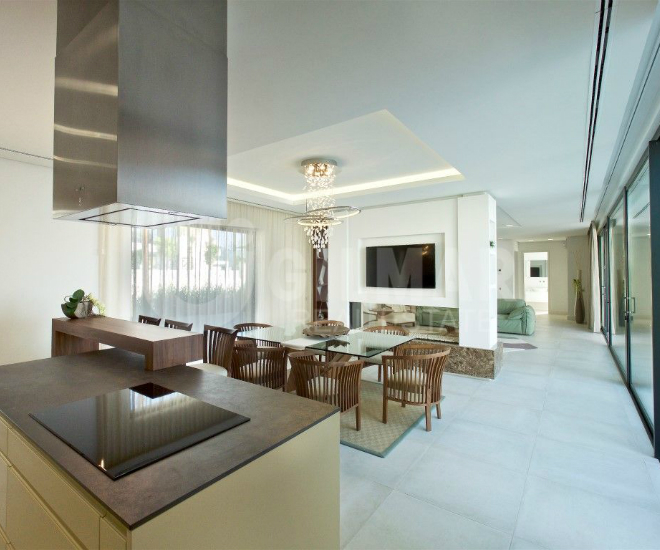
Up on the cards in Spain’s luxury property market due in Q3 2018 is 14 contemporary-style 5-bedroom luxury villas in La Alqueria, Benahavis, Marbella, Spain. This gated community is built on an elevated plot with enviable vistas of countryside, Mediterranean Sea and nearby golf courses.
The charming Benahavis village and Estepona town as well as Puerto Banus and Marbella are all a stone’s throw away. In actuality, this plush development offers three different types of 5-bedroom villa designs where the best quality materials and environment friendly technologies are utilised. More interestingly, each villa will feature salt water swimming pools, terrace areas and manicured gardens.
Vaughan adds, “We are seeing a huge growth in what we call “Lifestyle Investors. They want to make a wise property investment (and) choose Spain because of the quality of life it offers.”
“As we have been saying for the last couple of years, the key for investors in Spanish property is to focus on location. The prices of properties in prime areas will recover first and now is a great time to take advantage of low prices and buy in the best micro-location you can for your budget.”
In fact, the increase in airport arrivals over the past 10 years means that Barcelona, Malaga and Valencia are still consistently popular with tourists looking for short-term property rental. This has led to many investors seeing the potential of buying a property to let as rental prices are gradually heading north.
Ibiza – a party-goers’ paradise – is also witnessing record breaking visitorship – it is set to break 8 million (as reported by Aena SME, a state-owned company that manages general interest airports and heliports in Spain).
The Association of Property Registrars in the Balearics has reported a tripling in the number of foreign-bought homes and it is the luxury end of the market that is attracting keen interest, with 15 per cent of purchases topping €500,000 (US$564,000). Unlike mid-market purchases, prime market properties are being purchased for either long term investment or for use as holiday homes.
Another popular area, Marbella has seen a growing interest amongst Middle East royalty and affluent US and Chinese buyers. It seems buyers are attracted to the year-round outdoor lifestyle, high quality services, vibrant restaurant scene, solid infrastructure and good international schools. In particular Marbella’s Golden Mile, including developments such as Nueva Andalucia, Sierra Blanca and Benhavis, is so popular that demand for property is outstripping supply.
The exclusive new development in the popular “Golden Mile” area of Marbella will offer 3- and 4-bedroom luxury apartments and 4- and 5-bedroom penthouses, all within a few minutes of the exclusive marina of Puerto Banus.
Text by Joanne Pasquale and Kate Everett-Allen | Additional reporting by Joe Lim
This article was originally published in the 2015 issue of Palace and updated on April 23, 2018.
Southeast Asia’s luxury lifestyle event PENANG RENDEZVOUS 2018 will launch in July
Organised by Asia Rendez Vous Pte. Ltd., The PENANG RENDEZVOUS 2018 is a “must-attend” event for those who embrace the finer things in life. The four-day event, taking place from July 26-29, 2018 will focus on a comprehensive showcase of yachts, classic cars, supercars, sea planes, helicopters, watches, properties, fine cognac and art for aficionados, existing clients and prospects.
Alongside the yachting showcase, professionals from all aspects of the marine and luxury lifestyle sectors can explore opportunities through mingling in a relaxed atmosphere, with plenty of time to network, exchange ideas and information with fellow attendees.
After successfully hosting the Phuket Rendezvous and Singapore Rendez Vous, the experienced and passionate team at Asia Rendez Vous Pte. Ltd. is ready to bring their own touch of luxury to the PENANG RENDEZVOUS.
“It gives us a great pleasure to extend a warm welcome and appreciation to Asia Rendez Vous Pte. Ltd. for bringing PENANG RENDEZVOUS to Strait Quay Marina. We look forward to a gathering of the region’s premier and international brand names that this exceptional event is set to draw. Make a date with us at this event of the year in Straits Quay Marina.” – Ms Emily Teh, Senior General Manager
The PENANG RENDEZVOUS welcomes exhibitors to take up residence at the superb Straits Quay Marina in support of the show. Come and experience the World of Luxury at The PENANG RENDEZVOUS curated just for you.
For all queries, please email to info@penangrendezvous.com. Follow the latest news on Penang Rendezvous at @penangrendezvous on Instagram.


 Volkswagen has announced that it is planning to stop production of its Beetle once again, although there is no specific timeline as of when. However, the Beetle is certainly no ready to disappear off the production line yet. Customization experts Memminger is known for its restorations of the Volkswagen Beetle since the mid-‘90s. It just released its own custom concept of Memminger Roadster 2.7, named after the liter size of the air-cooled boxer engine.