The painting ‘Retrato de una nina’ (‘Portrait of A Girl’), believed to have been done by late Spanish artist Diego Velazquez. Image courtesy of Gerard Julien / AFP
The ‘Portrait of A Girl’, which portrays a young girl with large, sad eyes, her hands held together as if in prayer, is believed to be an early work by Sevillian artist Diego Velazquez. Velazquez is best known for his masterpiece ‘Las Meninas’, on display in Madrid’s Prado Museum.
It is believed to have been painted by Velazquez around 1616 or 1617, when the artist was only 17 or 18 years old and still living in the southern Spanish city of Seville, the auction house said. It had been in the same family for several generations but had never been properly analysed until the owner decided to sell it.
Richard de Willermin, a specialist on 17th century Spanish art who collaborates with the auction house, examined the small oil on canvas painting and concluded it was by Velazquez. Specialists at the Prado Museum have also looked at the painting, but the museum has not commented publicly as it never gives any opinion about works that are not part of its own collection.
Diego Velázquez, ‘Las Meninas’ (‘The Ladies-in-Waiting’), 1656 to 1657, oil on canvas. Image courtesy of Museo del Prado (Prado Museum) and Wikimedia Commons
The painting’s starting price had been eight million euros (USD 8.7 million), Abalarte said, but there was no higher bidding.
The identity of the buyer was not revealed, but the painting is banned from leaving the country by order of the government, which prohibits any work that could be part of Spain’s heritage from being taken abroad.
A slow and meticulous worker, Velazquez is thought to have painted fewer than 200 works in his entire career. About 120 survive to this day, roughly half of them in the Prado.
The HYT Skull Pocket’s case has been upsized from 51 millimetres to 59 millimetres
Melding fluid dynamics with the principles of mechanical gearing in watchmaking has been HYT’s raison d’être since its inception, and the brand has created numerous variations on the theme of time indication using liquids. The latest from these self-styled hydromechanical horologists is the Skull Pocket, which places the familiar Skull watch in a pocket watch format — a first for HYT — while updating its design and features.
Reading the time on the Skull Pocket remains unchanged. In lieu of hands, a fluid module marks the time with two immiscible liquids, whose relative levels in the glass tube are controlled by the alternating expansion and contraction of the flexible bellows at six o’clock. The bellows’ motions are, in turn, driven by a mechanical movement, which also drives the spinning discs in the skull’s eyes to mark the running seconds and power reserve. Twice a day at six o’clock, when the green liquid completely fills the glass tube, the bellows “reset” themselves and send the green liquid leftwards in a retrograde motion, before the liquids resume their clockwise trek again.
Fluid module aside, the Skull Pocket also has the lighting system that debuted in the H4 Metropolis. Winding and pushing the crown at four o’clock tightens and releases a spring respectively to drive a dynamo, which converts the spring’s mechanical motion into electricity. This powers the two LEDs at six o’clock that then bathe the dial in blue light for around five seconds — a relatively novel way to display the time in the dark sans luminescent paint or batteries. The play with light is accentuated by the updated dial design, which sports a faceted skull on a black background executed in the Clous de Paris guilloché pattern.
Dial view of the HYT Skull Pocket
The Skull Pocket’s case has been upsized from 51 millimetres to 59 millimetres, with the original’s lugs making way for a chain attachment and a hinged lid à la hunter-style pocket watches of yore. An all-titanium construction keeps the watch manageable weight-wise despite its size. This watch is limited to eight pieces.
Specifications
Movement Hand-wound HYT calibre with fluid module Power Reserve 65-hour Case 59-millimetre in titanium and DLC-coated titanium Water Resistance Up to 50 metres Strap Titanium chain with titanium swivel clasp Price Unavailable
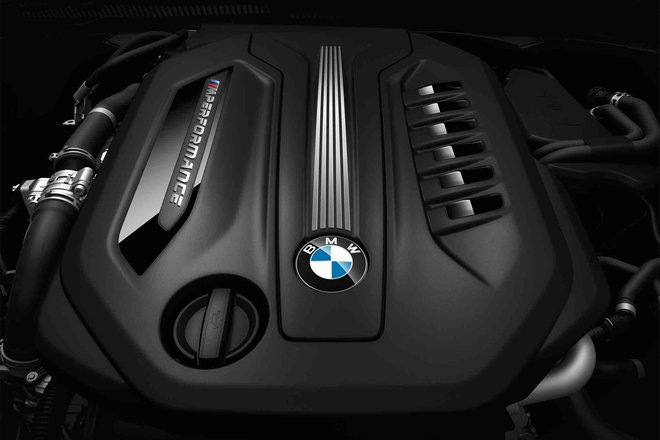
Diesel has been seeing downturn on its luck in recent years. But thanks to a diesel powertrain, BMW‘s latest ‘M’ badged 5-Series model—the M550d xDrive—is as big on power as it is on responsibility, so much so that it could help rehabilitate the fuel’s reputation. Although the company’s ‘M’ division is now spreading its wings and adding flourishes of motorsport technology or styling to a host of BMW models, rather than simply concentrating on making pure, undiluted ‘M’ variants of each production car, a BMW with the M badge on its rear, is never a marketing gimmick.
So, for the M550d xDrive to earn the right to wear the M badge, it has to offer something a bit special, regardless of what type of fuel it runs on. And here, the car doesn’t disappoint as owners will be able to claim their car has the most powerful six-cylinder diesel ever fitted to a production automobile.
It has three liters of displacement, four turbochargers and 400hp. As for torque, a diesel engine’s trump card, there’s 760Nm on offer and it is accessible from 2,000rpm. It may come with an electronically restricted 250km/h (155mph) top speed, but on the way to that figure it will hit 100km/h in just 4.4 seconds. Plump for the bulkier, heavier Touring (station wagon) version and it will still manage that dash in 4.6 seconds.
But M cars have to be fun in the bends as well as on the straight so the M550d xDrive comes with intelligent all-wheel drive, sharper suspension, an eight-speed sports transmission and a ride height dropped by 10 milimetres for improved centre of gravity.
Diesel may have a dirty name at the moment, but in the short term at least, the fuel’s efficiency is going to be crucial in helping truly global car companies meet tighter emissions and economy standards.
It’s why Mercedes invested over €3 billion developing its latest generation ultra-efficient, lightweight OM 654 diesel powertrain that debuted in its E-Class in mid-2016. It’s also why Bentley, a company founded on very torque-y gasoline V8 engines and laterally W12 twin turbo blocks has finally started offering its most fuel-thirsty car—the Bentayga SUV— with a diesel option.
The M550d xDrive has a gasoline sibling, the M550i. It has a 4.4 liter V8 calling the shots and it’s 0.4 seconds faster off the line, has 62 more horsepower but just 650NM torque. It offers a combined fuel economy of 8.9l/100km and 204g/km in terms of CO2 emissions. The M550d returns 5.9l/100km on the combined cycle and 154g/km of CO2.
Molecular Science and Biochemistry building, Brutalist Sydney Map. Image courtesy of Glenn Harper
The Brutalist architecture aesthetic has always provoked extreme reactions. Considered “concrete eyesores” in the past, the perspective has shifted considerably, yielding a rising popularity and even a “design icon” status. London-based independent city guide publisher Blue Crow Media has accordingly placed a spotlight on this genre. A Brutalist guide to Sydney was released Monday (following three previous Brutalist maps of London, Paris, Washington; a Brutalist Boston Map will also be available in Spring 2017). The publisher has also released other internationally-minded maps highlighting urban Art Deco and Constructivism.
Sydney Town Hall, Brutalist Sydney Map. Image courtesy of Glenn Harper
The Brutalist Sydney Map encompasses 50 of the most significant examples, within the city and suburbs. Lesser-known structures include the Buhrich House II (conceived by the émigré architects Hugh and Eva Buhrich) and the Eastern Suburbs Railway Vents (attributed to Mansfield Jarvis and Maclurcan). There are edifices that may need to be commemorated through the photographs, like the Sirius Apartments, by Tao Gofers and the former New South Wales (NSW) Housing Commission (likely to be sold without heritage listing), and Bidura Children’s Court, by former NSW Government Architect (now sold and likely to be demolished).
Bidura Children’s Court, Brutalist Sydney Map. Image courtesy of Glenn Harper
Brutalism by the mid-1970s was well-adopted within the architectural practices of Sydney. The city’s luminous disposition seemed an ideal setting to highlight the textured surfaces of this architectural approach. Key to the adoption of this was the NSW Government Architect and the design architects of the NSW Public Works Department. The range of public projects in this style was pushed forward through collaborations with European-trained émigré architects.
A Bentley Azure painted with two million diamonds, on show at Top Marques Monaco 2017. Image courtesy of Top Marques Monaco 2017
This year’s edition of the Top Marques Monaco luxury car show was held April 20 to 23 in the principality, setting the stage for some spectacular world premieres.
The Monaco event, billed as the world’s most exclusive car show, featured a host of exceptional new vehicles and saw four supercars make their worldwide debut: the Donkervoort G8 RTO, the Calafiore C10, a Charlotte Edition of the Asfané by Frangivento and a Mini revisited by David Brown Automotive.
The D8 GTO-RS is the fastest and lightest supercar ever built by Dutch car maker Donkervoort. It is a limited-edition 40-car model (starting at just over €150,000 excluding taxes, which roughly translates to USD 165,000 sans tax) that is more powerful than the current range, with improved aerodynamics for even more impressive acceleration. Italian brand Calafiora presented the C10, which has been under development for no less than seven years. It has a lightweight carbon fibre chassis and tops 1,000 horsepower.
Another show highlight was Frangivento’s special edition Asfané, the Charlotte Edition, named after the Princess of Monaco. This model is directly derived from the concept car unveiled by the Italian manufacturer earlier this year. Capable of topping 300 kilometres per hour, it’s expected to set buyers back at least €1.8 million (approximately USD 1.97 million). British car maker David Brown Automotive presented an original Mini. The firm’s Mini Remastered, as seen in the video below, is particularly modern with its LED headlamps and seven-inch touch screen and uses luxurious materials like leather and aluminium.
In a different style, the show also featured a Bentley Azure painted with two million diamonds from the Jean Boulle Luxury group, and Vanda Electrics revealed a two-seater all-electric Dendrobium concept car capable of topping 320 kilometres per hour.
Tang Kok Soo, ‘Elephants Crossing the Water’, mixed media
The first element that strikes viewers looking at Tang Kok Soo’s painting ‘Elephants Crossing the Water’, is the unusual placement of bodiless ‘eyes’, taking the form of small black dots dispersed throughout the painting. A signature feature in his ‘Stone’ series, as are the whimsical specks of colour on the canvas, these ‘eyes’ direct ours to different elements in the painting and foreground the coming together of individual lives in a community.
Conveying a sense of resilience and groundedness of its mammal subjects in the face of a challenge, Tang’s painting won the 2016 United Overseas Bank (UOB) Painting of the Year (POY), Singapore (Established Category — Gold award). Artists and gallerists in the nation would undoubtedly know of the competition, established by UOB in Singapore back in 1982. Conceptualised with the vision of supporting rising talents in the local art scene, the award has proven a prestigious title for local artists to aspire to. Cultural Medallion recipients Anthony Poon and Chua Ek Kay are but part of its illustrious alumni.
Clinching one of the top prizes in the competition that recognised these artists who made a mark on Singapore’s art history is a testament to Tang’s meticulous technique and creativity. Charcoal, watercolour and Chinese ink, three of his choice materials, are skilfully applied on the canvas. For the dry and wet materials to co-exist, the painting must have been done layer by layer, lending an undoubted sense of materiality to the final piece. Lines and shapes tease elephant figures, but distinct outlines ultimately elude the viewer, who is left content to address the painting as a cross between figurative painting and Russian abstraction art.
For the Johore-born Tang, the road to practising art and winning the 2016 UOB Painting of the Year, Singapore (Established Category — Gold Award) was a winding one. Exposed to watercolour and oil painting techniques at around age 11, Tang uncovered a deep longing for making art. The age of 38, however, saw Tang as an engineer, who decided then to dedicate his time to making art full-time instead. Clinching the award was one of the ways in which his decision bore fruit.
Tang Kok Soo, 2016 UOB Painting of the Year, Singapore (Established Category — Gold Award) Winner
Another way in which this decision is proven a favourable change, of course, is Tang’s first solo exhibition, ‘Tang and Tranquility’, showing at the UOB Art Gallery from April 12 to May 19. Entering into Tang’s world, the viewer straddles between cityscape paintings bathed in yellow, with streaks of light rendered so realistic that the streets in these paintings might just be alive, to the skilful use of grey to create the illusion of texture in his ‘Stone’ series. The occasional vibrant red and blue hues play an important role of imbuing the paintings with perspective and a sense of life.
Tang Kok Soo shares the motivations behind his practice, and how winning the 2016 UOB Painting of the Year, Singapore (Established Category — Gold Award) has shaped his path as an artist.
You are a firm believer that moral character and qualities shape the art you create. How do your values influence your work?
My life as an artist is meaningful as long as I know that my artworks contribute to the betterment of society. I believe that even if art does not contribute to society, it should not harm or negatively influence society.
There is no one standard for art. However, the artist’s state of mind and intentions should be sincere and pure, as they come through to the viewers who appreciate their artworks. That should be the ultimate aspiration of an artist — to have an unwavering conviction to create art that aligns with the artist’s inner-self and purity of heart.
I draw inspiration from the Confucian saying, “In the Classic Poetry or Book of Song, or 诗经 in Chinese, are three hundred pieces, but the design of all of them may be embraced in one sentence — ‘Having no depraved thoughts’”.
As an artist, I strive to uphold a high standard of conduct and morals, so that my paintings will embody a positive message.
You believe that art has the power to leave a positive mark on society. In what way do you think your art will leave a legacy?
I believe that artworks give viewers a glimpse into the inner world of the artist. I try to channel positive energy and compassion through my artworks with the hopes that it will have a positive impact on the art community and society.
Tang Kok Soo, ‘One Heart’, mixed media
Who has helped you or made an impact on you along the way to making art achieve the purpose you would like it to achieve?
My wife has been a true pillar of support in my journey to become a full-time artist. She is my mirror and a beacon for me to look up to. Her sincerity and compassion never fail to shine through no matter how difficult our journey is.
I also have an artist friend whom I consider to be a true confidante. He knows my artistic ambitions, what inspires me, and my passion.
Mindfulness and positivity characterise your work. Why is it so important to be positive? Why must you develop your art in that direction?
Art is about reaching a common level with the viewer, to be able to move them subtly and gently. As a full-time artist, I paint daily for eight to 10 hours, if not more. I am usually alone when I paint, and this gives me the opportunity to get in touch with my inner voice. As I do not have many opportunities to interact with people, I hope to impart positive messages through my artworks. I believe that true creativity stems from one’s heart and inner self.
You use mixed media and watercolour in your paintings. Why? What made you decide that the materials and medium you used was necessary to express what you want to express?
There is no fixed form or framework for creating good works of art, so I try not to restrict myself to any specific technique.
From a commercial perspective, recreating popular artworks with the similar techniques and styles may help to boost sales. However, being too entrenched in a singular concept or technique may block the artist’s creativity and hinder the evolution of their artworks in the long term.
Tang Kok Soo, ‘Cattle Stockmen’, mixed media
You were born in Malaysia, spent your childhood in Brunei, then came to Singapore in 1986 and discovered painting and art. How have these places influenced your paintings?
I spent my growing years in Brunei, where I learnt to live simply with a contented heart.
I have spent the past 31 years in Singapore, where I built my career and started my family. Singapore is where I belong. It is in Singapore where I built my vision, honed my outlook in life and developed my passion for the arts.
Singapore was where you learnt watercolour and oil painting, and fell in love with art. For many years, you treated art as a hobby. What made you leave your job in engineering in 2013 to become a full-time artist? What were the thoughts going through your mind? Was the switch a drastic or gradual process?
In 2009, I crossed paths with two artist friends, Tay Bak Chiang and Ng Woon Lam, whom I knew during my younger days when I used to spend time at Nanyang Academy of Fine Arts (NAFA) and the Federation of Art Societies Singapore.
I learnt about their success as artists, after which I reflected on what had I been doing over the past decade. I felt that I had wasted valuable opportunities by discontinuing my practice of fine art, and was filled with a sense of emptiness. Thereafter, I picked up my paintbrush again and started painting during my free time.
In 2013, at the age of 38, I realised that was nearing my golden age and did not want to look back on life with regrets. With the invaluable support of my wife, I gave up my stable career in engineering to practice fine art full-time.
To quote Confucius, “At fifteen my heart was set on learning; at thirty I stood firm; at forty I had no more doubts; at fifty I knew the mandate of heaven; at sixty my ear was obedient; at 70, I could follow my heart’s desire without transgressing the norm”. Today, as I reflect upon this sentence I regret not pursuing art from the age of 15. At my current age of 41, I hope to remain firm in my goal and make up for lost time by working on my art every day.
Tang Kok Soo, ‘Thriving’, mixed media
Where did you learn painting in Singapore? Were you influenced by other artists of that time?
I am a self-taught artist; my passion and enthusiasm for art drive me to learn as much as I can. I read a lot of art-related books and I spend a lot of time in museums and art galleries.
We often start off doing something without recognising ourselves as a person who is competent at it. At what point did you realise you were not just a person making art, but you were an artist?
When I decided to become a full-time artist in 2013, it was with the clarity of mind that I wanted to create art that would contribute to society. It was also spurred by my desire to work hard as an artist to make up for lost time.
Tang Kok Soo, ‘Joyfulness’, mixed media. ‘Joyfulness’ has been sold at Art Stage Singapore 2017
You won the 2016 UOB Painting of the Year (POY), Singapore (Established Category — Gold Award). Why did you choose to join the competition? What does this recognition mean to you as an artist?
When I became a full-time artist at 38 years old, I was not well known in the art community. Winning the 2016 UOB Painting of the Year (POY), Singapore (Established Category — Gold Award) boosted my confidence in my artistic abilities and affirmed my decision to pursue art as a career.
The UOB Group Strategic Communications and Customer Advocacy (GSCCA) team engaged me shortly after the win to organise my solo exhibition at the UOB Art Gallery. They worked closely with me to curate the artworks for the exhibition and select the exhibition theme, and to organise media interviews, a gallery tour and photography to profile my exhibition to UOB employees and the public. The entire process was new to me.
My winning artwork was selected as the inspiration for the design of the 2016 UOB Annual Report. I was honoured and pleasantly surprised that my artwork was selected due to the positive message behind my work.
I appreciate the efforts of the UOB GSCCA team, who worked tirelessly to make all the arrangements for my first solo exhibition; from the design and printing of the exhibition catalogue to giving me an enormous push to promote my works to the public through the Bank’s regional network.
Going forward, I hope to continue creating art with a sincere and pure heart and to explore new painting techniques.
Tang Kok Soo, ‘Tenacious Wish’, mixed media
Has winning the 2016 UOB Painting of the Year, Singapore (Established Category — Gold Award) paved the way for more exhibition opportunities?
Yes, definitely! With the UOB Painting of the Year (POY) competition, I was able to showcase my artworks on a regional level, and network with UOB POY artists from around across the region.
Since winning the 2016 UOB POY competition, I have broadened my clientele base to a wider audience which I normally would not be able to market to. This includes regional art collectors and new collectors.
I have exhibited my artworks at the UOB Art Space @ Art Stage Singapore 2017 alongside 14 other UOB POY artists from around Southeast Asia. I am honoured to host my first solo exhibition at the UOB Art Gallery. I sincerely thank UOB, especially the UOB GSCCA team, for giving me the chance to launch my first solo art exhibition at UOB’s headquarters in Raffles Place, Singapore.
Tang Kok Soo, ‘Memories #3’
We would like to thank UOB for relaying the questions to the artist in Chinese, and transcribing and translating the interview as shown above.