Home Blog Page 645

Luxury spending trends 2017: Japan second largest luxury market in the world

0

Tight-fisted shoppers, unsteady economic growth and a shrinking population: Japan doesn’t exactly fit the image of a spending powerhouse these days. But you would never know it in Ginza — Tokyo’s answer to the Champs-Elysees or Fifth Avenue — where a new 13-storey upscale mall is proving that Japan is still a whale in the luxury business.

The country logs some $22.7 billion in annual spending on top-end goods made by brands including Chanel, Dior, and Prada, ranking it as the world’s number two luxury market behind the United States. “Luxury products may be more expensive, but they are very well-made,” said 79-year-old Toshiko Obu, carrying her longtime Fendi bag outside the Ginza Six building, which has been drawing big crowds since last week’s opening.

Japan is renowned among the world’s priciest retailers for its discriminating clientele—Chanel tries to keep local customers physically separated from tourists packing more cash than class. “You shouldn’t forget that a big portion of the luxury clientele is here in Japan,” Sidney Toledano, chairman and CEO of Christian Dior Couture, told AFP at the opening of the 241-store building. “It remains a strategic market for luxury and, I’d say, true luxury.”

‘Biting their fingernails’

Dior is counting on Japan’s luxury market to rise this year, while rival Chanel is also expecting an upbeat 2017 after global sales of personal luxury goods barely grew last year. “We did not lose our character,” said Richard Collasse, head of Chanel in Japan. “There are brands that are suffering—the ones that at some stage stopped investing in Japan because China was the new El Dorado. And today they are biting their fingernails.”

Few brands predicted that deep-pocketed Chinese shoppers visiting Japan would support its luxury market—tourists account for about one-third of top-end spending.

Japan is hoping to land 40 million visitors in 2020, the year that Tokyo hosts the Olympics. Last year, some six million Chinese visited, compared with 2.4 million in 2014. “Historically, (Japan has) been a very insular luxury market where 90 to 95 percent of the spending was by locals,” said Joëlle de Montgolfier, Paris-based director of consumer and luxury product research at consultancy Bain & Company. But now some 30 percent of sales are generated by foreign visitors owing to tourism, she added.

A stronger yen dented visitors’ purchasing power last year, with luxury sales down one percent, after a nine percent rise in 2015. Dior’s Toledano said it is an opportunity to refocus on Japanese clientele. “We don’t ignore tourists, of course, but we’re not a duty-free shop,” he added.

‘Touching everything’

Some other Chanel shops in Tokyo have a separate cosmetics and perfume section reserved for top Japanese customers, in a bid to keep them away from the nouveau riche crowd. It also tips off local clientele about the expected arrival time of tourist buses so they can avoid them.”The loyal Japanese clients tend to run away from customers who were not very well raised and are wearing whatever or lying all over the sofa, touching everything,” said Chanel’s Collasse.

Dior’s haute couture show at the new mall’s opening featured Japanese-inspired dresses, underscoring a focus on the local market. But warning signs lurk behind smiling clerks and glitzy interiors at the new property on one of the world’s priciest shopping streets. Japan has struggled to reverse a decades-long economic slump while a falling population continues to shrink its labour force—and the pool of future luxury consumers.

Younger people, many on tenuous work contracts, don’t have the money or the same interest in luxury brands anymore, especially since top-end goods can now be rented online instead, said Naoko Kuga, a consumer lifestyle analyst at Tokyo’s NLI Research Institute. “When you look at consumer purchasing behaviour, younger people put less value on luxury brand products” than previous generations, she said.

Parisian Louvre pyramid designer I.M. Pei turns 100

0
The Louvre Pyramid, designed by Chinese-American architect I.M. Pei, in the courtyard of the Louvre Museum

The Chinese-American designer endured a roasting from critics before the giant glass structure opened in 1989, with up to 90 percent of Parisians said to be against the project at one point.

“I received many angry glances in the streets of Paris,” Pei later said, confessing that “after the Louvre I thought no project would be too difficult.”

Yet in the end even that stern critic of modernist “carbuncles”, Britain’s Prince Charles, pronounced it “marvellous”.

And the French daily Le Figaro, which had led the campaign against the “atrocious” design, celebrated its genius with a supplement on the 10th anniversary of its opening.

Pei’s masterstroke was to link the three wings of the world’s most visited museum with vast underground galleries bathed in light from his glass and steel pyramid.

It also served as the museum’s main entrance, making its subterranean concourse bright even on the most overcast of days.

Pei, who grew up in Hong Kong and Shanghai before studying at Harvard with the Bauhaus founder Walter Gropius, was not the most obvious choice for the job, having never worked on a historic building before.

But the then French president Francois Mitterrand was so impressed with his modernist extension to the National Gallery of Art in Washington DC that he insisted he was the man for the Louvre.

The Socialist leader was in the midst of attempting to transform Paris with a series of architectural “grands projets” that included the Bastille Opera and the Grand Arch of La Defense.

Already in his mid-60s and an established star in the United States for his elegant John F. Kennedy Library and Dallas City Hall, nothing had prepared Pei for the hostility of the reception his radical plans would receive.

He needed all his tact and dry sense of humour to survive a series of encounters with planning officials and historians.

One meeting with the French historic monuments commission in January 1984 ended in uproar, with Pei unable even to present his ideas.

“You are not in Dallas now!” one of the experts shouted at him during what he recalled was a “terrible session”, where he felt the target of anti-Chinese racism.

Not even Pei’s winning of the Pritzker Architecture Prize, the “Nobel of architecture” in 1983, seemed to assuage his detractors.

Jack Lang, who was French culture minister at the time, told AFP he is still “surprised by the violence of the opposition” to Pei’s ideas.

As the Louvre is the former palace of the country’s kings, Lang notes that “the pyramid is right at the centre of a monument central to the history of France“.

“The project also came at a time of fierce ideological clashes” between the left and right, he added.

The Louvre’s then director, Andre Chabaud, resigned in 1983 in protest at the “architectural risks” Pei’s vision posed.

The present incumbent, however, is in no doubt that the pyramid is a masterpiece that helped turn the museum around.

Jean-Luc Martinez is all the more convinced of the fact having worked with Pei over the last few years to adapt his plans to cope with the museum’s growing popularity.

Pei’s original design was for up to two million visitors a year. Last year the Louvre welcomed nearly nine million.

For Martinez the pyramid is “the modern symbol of the museum”, he said, “an icon on the same level” as the Louvre’s most revered artworks “the Mona Lisa, the Venus de Milo and the Winged Victory of Samothrace”.

The Eiffel Tower, now synonymous with Paris, faced opposition during the time of its construction

Pei is not alone in being savaged for changing the cherished landscape of Paris.

In 1887, a group of intellectuals that included Emile Zola and Guy de Maupassant published a letter in the newspaper Le Temps to protest at the building of the “useless and monstrous Eiffel Tower“, an “odious column of sheet metal with bolts”.

Chartering Fraser Yacht award winning motor yacht, Askari, to tour French Polynesia

0

Like David Jamieson in Fiji, visitors to French Polynesia could well consult long-resident Etienne Boutin of Tahiti Ocean. He and David have recently linked up with the Asia-Pacific Superyachts network, and Etienne, who plans stepping back a little, recently also opened Noumea Ocean in French-speaking New Caledonia.

A casual inquiry about the current crop of charter vessels elicited information about the sport fisher Ultimate Lady, Miss Kulani, Cosmos II, Senses, Ethereal, Ohana et al, but he also mentioned not to overlook the stately 33 metre motor yacht Askari, for which he is the port agent.

“Captain Claude Aker, and his chef and wife Emma received the Fraser Yachts award for Best Charter Crew Under 50m at Monaco Yacht Show last year”, he said. “She is a successful charter yacht in Tahiti since 2006, and has had record bookings for the South Pacific in the past decade.

“She is the perfect exploration yacht for French Polynesia, accommodating ten guests in comfort, and she has plenty of toys and diving gear to help explore remoter islands of the Tuamotus. Their central agent is Patricia Codere at Fraser Yachts in Fort Lauderdale”.

Fraser Yachts confirms that indeed Askari is available for charter in the Society Islands or Les Isles Sous Le Vent, where Raiatea and Bora Bora are located, and in the Tuamotus. In fact, says marketing executive Marie-Léa Dubourg, Askari is very open to cruising other unique South Pacific waters.

Although built in 1971, she has been kept in very good condition, as the photos show. Principal tender is a 17 foot 100 HP Caribe Jet, and there is also a 20 foot Caribe diesel jet RIB. Toys include double and single kayaks, stand-up paddle boards, snorkel and fishing gear, waterskis, wake board, kite boards, and jet skis only on request. A dive guide is required at the charterer’s expense, and the vessel carries a Capitano compressor.

For more information, do visit Fraser Yachts.

Interview with Singaporean artist behind ‘Atlas of Mirrors’ at Singapore Biennale 2016, Melissa Tan

0
Melissa Profile Shot © Melissa Tan

In the six years since her graduation from LASALLE College of the Arts, Melissa has completed two solo exhibitions, 12 group exhibitions (domestic and international), an overseas residency, two art fairs, mentored several emerging artists and most recently participated in the 2016 Singapore Biennale. With a studio space at Goodman Arts Centre, her practice has enthralled us with her meticulous interpretation of the natural and built world through her delicate paper cuts and exploration of materiality.

Melissa’s industrious streak could possibly be attributed to the cohort she graduated from that boasts many familiar names such as Ashley Yeo, Godwin Koay, Kel Win Wong, Ruben Pang, Weixin Chong, to name a few, each of them as dynamic and productive as the other. Perhaps this is a sign of exciting times ahead for Singapore contemporary art? Melissa’s practice sheds some light on this up-and-coming batch of artists.

There has been positive response to your 2016 Singapore Biennale work. Could you share how this piece came about?

I have always been interested in geography, and was curious to find out more about the types of bedrock in Singapore. I noticed the numerous granite quarries and realised how rapidly we have depleted our resources. The granite from Pulau Ubin and Bukit Timah was used to build the city’s infrastructure, such as the causeway bridging Singapore to Malaysia and the Horsburgh Lighthouse.

For ‘Atlas of Mirrors’, I wanted to revisit this idea of utilising granite in my work. It was after walking through the CBD (Central Business District) area that I found various types of granite being used as building material. I also observed that materials from other countries were grafted onto our landscape. At the same time, I wished to continue working with sound after experimenting with it during a residency in Paris. These ideas eventually led to my exploration of Singapore’s terrain and landscape. Looking at Singapore’s land allocation master plan, I decided to visit each section and collect different materials that were being used for urban planning.

Detail Shot of 'If You Can Dream a Better World You Can Make a Better World or Perhaps Travel Between Them'. Installation Shot at Singapore Biennale 2016 © Melissa Tan
Detail Shot of ‘If You Can Dream a Better World You Can Make a Better World or Perhaps Travel Between Them’. Installation Shot at Singapore Biennale 2016 © Melissa Tan

Working with a curator is relatively a new experience for you. Could you share the relationship between yourself and the curator in terms of artistic processes and how you worked with curatorial intervention?

It was an engaging experience working with the curators at the Singapore Art Museum. I felt that a lot of support was given to me throughout the process. We discussed the relationship of my past works with the current sculpture, and considered how a sound piece would resonate with the audience. It was a different experience understanding the curators’ perspective, including how they placed the sound sculptures to simulate a continuous dialogue between the works of Munem Wasif and myself, despite our different approaches to the notion of landscape.

There has been a current wave of interest on the notion of artist residencies in academia. Singapore itself boasts several residencies including the Centre for Contemporary Arts (CCA), Singapore Tyler Print Institute (STPI) and Grey Projects. As a participant of the Dena Foundation Residency programme, what were some of its positives in terms of enhancing your practice?

The exposure to more artworks overseas, getting to know how other practitioners work and experiencing different art scenes. During the Dena Foundation Residency Program, I stayed at the Centre International d’Accueil et d’Échanges des Récollets. As the centre believes in creating a space for discourse between people from different fields — researchers and artists, for example — I met artists from different disciplines, scientists and a marine archaeologist who were all deeply passionate in their practice. During the three months of my residency, I was fortunate to attend the myriad of events happening in the same time frame. Every residency offers something different, be it research, workshops, mentorship and so on. As artists, we need to know which residencies would help in terms of exploring and pushing one’s practice. I feel that is important to break routine, through travel and other means, and step outside your comfort zone in all aspects of an artist’s practice.

'1009 Sirene', 2016, Acrylic on Watercolour Paper and Powder-Coated Mild Steel. Artwork Shot © Melissa Tan
‘1009 Sirene’, 2016, Acrylic on Watercolour Paper and Powder-Coated Mild Steel. Artwork Shot © Melissa Tan

Which artists have you have consistently referred to in your practice?

I definitely look to my lecturers at LASALLE College of the Arts who have shaped my practice, including Betty Susiarjo, Hazel Lim, Jeremy Sharma, Ian Woo, to name a few. I admire Tacita Dean’s practice and how she pursues her narratives. Richard Long as well, for his sensitivity to drawing. His work ‘A Line Made by Walking’ made me think about the process and the relationship between nature and man. At the same time, I look up to local writers such as Arthur Yap for his poetic insights on the Singapore landscape.

Your practice is renowned for its physically laborious process. How do you situate your practice in this age of digitisation? On a scale of importance, where would you place the artist’s hand?

As I work closely with traditional printmaking techniques, it is very important to me. However, I am moving towards using laser cut metal in my practice and learning certain software to navigate this age of digitization. Perhaps it is difficult to see the artist’s hand in some works, but that does not make the process any less labour intensive. Editing images, building models through software and rendering data takes a lot of time and often goes unnoticed. I feel that in whatever we do, time and patience are still required to learn the craft and keep up with the pace at which technology is evolving.

Detail Shot of '1009 Sirene', 2016, Acrylic on Watercolour Paper and Powder-Coated Mild Steel. Detail Shot of '1009 Sirene' © Melissa Tan
Detail Shot of ‘1009 Sirene’, 2016, Acrylic on Watercolour Paper and Powder-Coated Mild Steel. Detail Shot of ‘1009 Sirene’ © Melissa Tan

You are exclusive to Richard Koh Fine Art. Could you share some of your experiences partnering a gallery and how it benefits your practice?

I guess artists are generally not as familiar with how a gallery works. Most artists, especially young artists, learn through good and bad experiences with the gallery. One aspect of working with a gallery is that they may help with marketing and look out for projects for the artist. This allows the artist to focus more their research, practice and making of works, such that they need not bother about the commercial side of things.

Being in a gallery that represents a cluster of artists that I admire also inspires my practice. For me, looking up to Nadiah Bamadhaj who works so well with paper and Haffendi Anuar who is multidisciplinary makes me want to create works that are exciting and relevant to our contemporary sensibilities.

What is next for Melissa Tan?

In 2017, I want to learn new software to help me with 3D printing and to constantly try new things to bring into my practice. Perhaps it is time to look towards a residency programme in Asia to re-assess my practice and expand my research interests. I am also currently working with Jason Wee on the MRT (Mass Rapid Transit) Art in Transit project that has been slated for completion in 2019 to 2023.

For more information, please visit rkfineart.com.

This article was written by Christiaan Haridas and originally published in Art Republik.

Audemars Piguet Royal Oak Perpetual Calendar in black ceramic

0
The Audemars Piguet Royal Oak Perpetual Calendar in black ceramic has a case with water resistance of up to 50 metres

Yes, the Royal Oak is a cash cow (no jokes about Swiss Made cows here) for Audemars Piguet. It is the kind of animal any watch brand would love to have in their stable. The model and its Offshore descendants have been offered in various sizes and materials, and played host to numerous complications, subject to the whims and fancies of those fine watchmakers in Le Brassus. Its cult status is beyond dispute.

The Royal Oak Perpetual Calendar is regarded by many as the go-to choice if they were to only choose one Audemars Piguet watch. What’s not to like about a watch with an iconic design, a respected complication and practical wearability? The latest size, introduced not more than than two years ago, is moderate too, at 41 millimetres. Potential buyers previously had only the choices of stainless steel or gold, but now a black ceramic option is introduced, priced somewhere in between those options.

Adding to the delight, the watch is paired with a full ceramic bracelet so it is better prepared for the tropics or outdoors than if it were to come with a leather strap. According to Audemars Piguet, producing, polishing and assembling this ceramic bracelet requires five times more man-hours than a regular one in stainless steel.

Close-up view of the dial of the Audemars Piguet Royal Oak Perpetual Calendar in black ceramic

The Grande Tapisserie dial is in a very dark slate grey, while the sub-dials are sunken and even darker for enhanced legibility. A central hand points to the number of weeks in the year on the dial flange. Although this is used on a more regional than global basis, it is a very good reminder of how much time we have left in the current year. It should also be noted that the graphical moon phase is the high accuracy sort, requiring one correction in just about 126 years.

At the heart of all the functions is the extra-thin automatic Calibre 5134. It is only 4.31 millimetres thick, thanks to the clever design where the outer radius of the rotor sinks into the recess around the periphery of the movement. A clear view of this is afforded by the sapphire case back.

Comparing this ceramic version with steel or gold is a futile exercise. There is a right watch for everyone and the right person to pick yours is you. That is all we have to say about that.

Specifications

Movement Self-winding Calibre 5134
Power Reserve Minimum 40-hour
Case 41-millimetre black ceramic
Water Resistance Up to 50 metres
Strap Black ceramic bracelet with titanium folding clasp
Price SGD 131,600

This article was originally published in WOW.

Environmentally friendly yacht: Benetti Meamina for charter in Maldives and Seychelles

0

Chartering in the Maldives and Seychelles this year, the 59 metre Benetti Meamina is an elegant, contemporary yacht. A fully equipped, action-packed vessel, she is a popular choice for families too, and is using Yacht Carbon Offsets to counter the greenhouse gas impact of fuel used.

Former Captain Steve Barker explains that this involves matching the greenhouse gas emissions from her engines and generators, ton for ton, with equivalent reductions from verified green energy projects. “Meamina is now operating in a more environmentally responsible way”, he says of the owners’ 2014 decision.

“Without compromising our very high standards, we have also re-evaluated many areas of daily operations, behind the scenes, and worked out ways to provide greener choices to guests on board. “Though we always seek to be fuel efficient, the fuel demands of a powerful, luxurious yacht like Meamina are vast. So it is great that we can respond effectively and economically to her greenhouse gas impact with Yacht Carbon Offset Limited”.

This company, based in London’s Mayfair, provides a fully- documented service for superyacht owners, and has Lloyds Register Quality Assurance Certification. Says their Mark Robinson: “We were delighted to welcome Meamina, and to help counteract her carbon footprint. This is increasingly important to many owners and charterers, especially those that are high profile, or who are concerned about the impact that their lifestyle may have on the climate.

“Meamina used a Gold Standard renewable energy project in Turkey for her initial carbon offset program. This venture was dependent on carbon funding, so Meamina’s action made a real difference. It is lovely to work with this beautiful yacht, and we thank all on board for their decision to proceed. More information can be found at yachtcarbonoffset.com.

Launched in 2009, Meamina is a full displacement motor yacht with a steel hull and aluminum topsides. Naval architecture is by Benetti, exterior lines by their Stefano Natucci, and Studio Massari took care of the interior design. The layout sleeps 12 guests in an immaculate master suite, an upper deck VIP stateroom, two double cabins and two twins. Up to 15 crew can be carried, including two world-class chefs and a qualified masseuse.

Powered by twin MTU V12 4000 turbo-charged engines, she has a top speed of 16 kts and range of 5,000 nm at 12 kts, a capability that has seen her in the Med, Caribbean, Pacific, Indian Ocean and Asia’s exotic seas and straits during a very fully-occupied eight years. Naiad stabilised when under way and at anchor, Meamina is classified by the American Bureau of Shipping.

Principal tenders are two 7.4m and 6m Pascoe jet drives. She carries two Yamaha wave runners, a stand-up wave runner, jet surf, wake boards, two stand-up paddle boards, two Eddyline kayaks, three bicycles, adult and child waterskis, snorkelling gear, inflatable towable toys, water slide, scuba gear, and there are both indoor and outdoor gymnasiums.

A Benetti spokesman says that apart from the classical purity of her white hull and superstructure, and exemplary Studio Massari interiors and decor, special attention was given to the owners’ private quarters. “Meamina is a true family yacht, designed for relaxing and comfortable cruising. The owner asked us to create different areas in the salons, and formal and informal social gathering places for the guests. The aim was to build a prestigious and impressive yacht with sophisticated decor and elegant furnishings. Interiors are pleasantly cosy”.

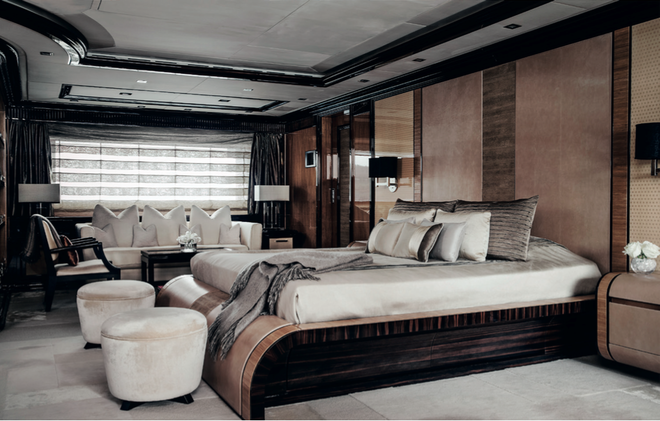
Of particular interest is the master suite, which has his and hers studies. Entrance is via her study, then there is a lounge and relaxation area beside starboard windows, with a sofa flanked by a pair of coffee tables and a bookcase on the wall.

A large double bed is centred. Here a flat screen TV drops down from an overhead recess, and beyond is a short hallway off which are dressing rooms. On the port side is a spacious bathroom with twin basins, tall cabinets, a tub and separate shower. Steps lead to a forward upper level within the master suite, where his study is located, complete with sweeping bow views, and a door giving access to the foredeck. Possibly the most prominent study we’ve ever seen on a superyacht.

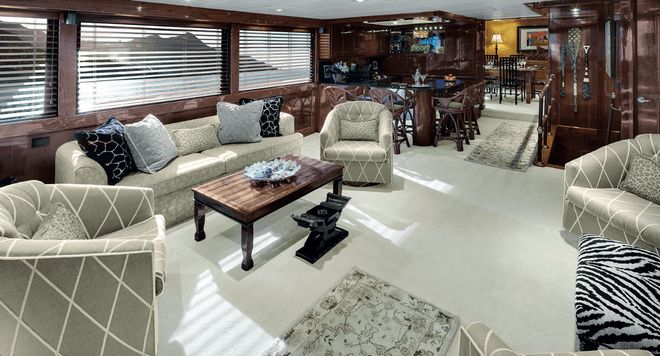
Guests staying in the VIP suite are also wonderfully located on the upper deck, sharing space with the sky lounge. The decks are variously arranged for wining and dining or sunbathing and swimming or relaxing in the jacuzzi, while within, off the principal salon, there is a formal dining table for 12 in a wood- panelled setting bathed in gentle ambient lighting. Even a small impromptu cinema can be set up. Definitely a lovely layout, and thoughtful use of all available spaces.

This vessel is available for charter via Burgess Yachts.

This article was first published in Yacht Style 38.

Get Exclusive Connections with LUXUO Thailand
Join us today
Connect!
Close
Join us for exclusive access to Luxuo Thailand's contents and events
Subscribe
close-image