Home Blog Page 607

Interview with Maryanto: Once Upon a Time in Rawalelatu

0
Maryanto, ‘Story of Space’ (installation view), 2017

“They ARE violent! They will kidnap you!” Regales Maryanto, on friends’ response to his a recent attempt at a jaunt into the warlord-guarded oil rigs in Africa. “I’m like, yeah! You think so? Okay, let’s find someone who can bring us in.”

The exchange epitomises Indonesian artist Maryanto’s ethos — a visceral approach almost detective noir-esque, jumping into the abyss. Much of his work involves inserting himself into strange and prohibited lands (not through arbitrary bravado, but of a bottomless curiosity), and him bringing back its beauty, horror and tales for a people who live untouched by the hidden atrocities of globalisation. The body of Maryanto’s work revolves around the issues of poverty, pollution and exploitation, and its geopolitical and local human consequences. These are woven through a web of historical research, myths and stories into his own artistic vernacular and vision, then, more often than not, saturated (or desaturated) into massive, brooding, monolithic charcoal drawings that channels beauty and the apocalypse at the same time. “Maryanto makes art to engage in social and political activism,” states the first lines of any text about his work. More than anything, he knows as well, like good war photographers will attest, there is a kind of sublime beauty in absolute horror.

Maryanto, ‘Story of Space’ (installation view) 2017.

As he lays the finishing touches on his solo show ‘Maryanto: Story of Space’ at Yeo Workshop, Art Republik caught up with him in the afternoon to ruminate on his work, and his politics.

A lot of your work deals with political activism. Having spent your formative years, in Indonesia under the Suharto regime, how would you compare those times to the current political climate? Is Indonesia moving in a more positive direction under democratic rule, or do the same problems still persist?

I was born in 1977, under the Suharto era. Most of the artists then were working politically and fought the government. There was tremendous pressure from the regime on artists, and they were gagged from speaking politically. To speak means one is “clashing” with the authority.

It’s almost impossible to make art without talking about politics, about people.

The way we talk about politics is changing. After the regime collapsed, artists were able to speak freely, so talking about politics wasn’t “cool” anymore. Previously it was: wow, you’re a rebel! Now it’s different.

To speak politically is to speak about the now and the future, and not just about the people. These days, artists don’t clash with the government. We talk about why people do the things that they do. You asked whether things are getting better or worse in a democracy. That’s the big question now. When freedoms are given to the people, groups get competitive. Now artists face problems from “people’s” organisations and religious groups. If say, I speak on LGBT, on communism, they don’t like it. It’s been happening in Yogyakarta, with people coming to shows and demanding for it to be shut because one is talking about the communists.

Today, it isn’t face-offs with the government anymore, but people against people. So to talk about politics now really is about how to make others understand the situation.

Maryanto, ‘Observation No. 4’, 2015

Your work, much as they deal with universal problems of the globalised economy, are very intentionally idiosyncratic to Indonesia. What is it like living in Indonesia, specifically Yogyakarta? Does it influence you?

Yogyakarta is the place that I really love; so many artists live here. It is not a place for the industry but for education. You’d be meeting people all the time and they’d be like “hey, I’m also an artist!” There are so many young intellectuals based there as well.

It’s different from Singapore. Yogya feels like we have 30 hours a day since we are so relaxed! Not exactly laziness per se, but we just have a lot of time. It’s a small city and things are intuitive and spontaneous. We can go to a friend’s house and be working on a new thing in a snap, and people are always genuinely happy to receive you. It’s like a community or an art ecosystem. Everyone is connected: activists, intellectuals, artists.

That is enviously cool. It is known that you imbue your work with theatrical devices/staging, with the deliberate intention of framing stories. I feel like the considered use of charcoal to make your lush, almost cinematic artworks aren’t too different from a cinematographer choosing to colour a film with a certain palette. Are narratives and stories something you think about in your practice?

When I make a drawing, I imagine the audience right next to me. I try to bring to people what I feel and see. I create a stage. That’s the only thing I can do. I can never bring you to the places I have been; I can bring you to the place I can feel, so that’s the experience I can give you. A friend saw my work and said, “It’s a bit sad.” Yeah, it’s sad; that’s the feeling I had when I saw (the destructive mess, on location) it. It’s sublime at the same time. And ironic. And these are the things I want to tell.

Maryanto, ‘We Were There Beb’, 2016

Works like these (points to ‘Randu Belatung’), we were in Yogya visiting an oil facility in the jungle behind the mountain. The area was named Randu Belatung. “Latung” means oil, since the area was surrounded by an oil rig. That is why I made this a monstrous, creepy thing. It could be that someday, people won’t think about planting the trees anymore and just think about taking the oil. Pipelines will come and transform the place into a massive operation and forestry will permanently disappear. It is a story of a space, because some areas have stories behind them, and I try to convey these stories.

I digress but sometimes I think about this: Singapore and Hong Kong are the only developed places in this part of the tropics, while the others here aren’t. In advertising, you always see an idealised beautiful tropical locale, and when I went to Nigeria, Jakarta, wow, the tropical people are in a terrible state. They’re really struggling, and there is so much resistance to life for them; it is not a paradise, it’s not a shared colonial perspective of “a tropical wonderland”.

I think it’s a bit funny, when people say certain parts of Indonesia is a tropical paradise — it’s a completely man-made mirage: cherry-pick old traditions, repackage it with a ribbon under the rubric of “authenticity” (shorn of the messiness), while the the actual denizens have to put up with an actual “drag” interpretation of their culture sold back to them.

That is true. Much of this is due to colonialism.

Do you think your work as an artist, as opposed to journalistic and political intervention/investigation, allows for a more dialectic, more meditative approach?

I feel artists have freedoms to say big things with their intuition. They don’t need exact data; the artist can say something they feel. For example, in this exhibition, my thoughts were occupied by the utopian “ideal life”. To talk about utopia, I’ll also have to talk about dystopia. I always think utopia is close to nature and life. That’s why in the back of the gallery, I show nature in its beauty and spiritual splendour. And then in the front, you see all the problems, with people violently stripping Earth of its resources.

You like to deal with parables, and obvious, jarring elements that one wouldn’t easily associate together: personified animals living their provincial kitchensink lives to massive, hulking industrial machines that almost look like dystopian mecha-weapons of mass destruction raining death from above. Are dualities something that you think about, and what about it interests you?

I think everything is ironic. My work is black and white. Everything resides in a “grey area’’ or a graduation. On that spectrum, you can choose the position and the ideal life you want to live. The personified animals were a part of my exploration into urban life, so everybody is a character: the rabbit is a factory worker, the dog is a policeman who follows the leader. Recently, I was on a trip to South Korea. People there hold in esteem the mountains and the river. It’s got me wondering: a life spent slogging in the factory, you die and your family puts your remains back in the mountain, and it’s like you’re back with nature.

Why work so hard in the mechanised factory, and still yearn to return to nature at the end? We need to rethink our approach to life. It’s so easy to find on Facebook 30-second videos that claim to know all of life’s answers! People just need to think more about their lives. It might be out of your control now, but you should still think of it. I feel that is important to at least be aware.

This article was originally published in Art Republik.

New Status Symbol: Your Own Home Luxury Spa

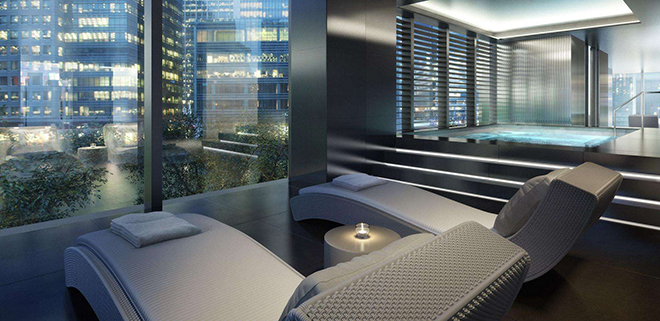
Aqua Platinum luxury home spa heat treatment facility

Once confined to the realm of cars, bags, watches and palatial luxurious homes arrives a new status symbol: your own home luxury spa. At home spas are a 2017 luxury home trend which spiked recently as luxury home owners started adding bio-saunas, iced lunge pools, experience showers, aquarium walls, and Russian style banyas in addition to their collection of Bill Viola art  and Yayoi Kusamas installations.

In context, whether you love art or merely use them as stats symbols for your mansion, the global art market achieved total sales of $63.8 billion in 2015; meanwhile, the global wellness industry encompassing all types of spas including the luxury spa offerings are estimated to be worth $3.7 trillion per year according to the Global Wellness Institute.

“It’s not just about having an indoor pool any more. Those who are committed to their health and wellbeing are opting for saunas, steam rooms, Jacuzzis, plunge pools, experience showers and spa pools with volcano jets and sprays for back, neck and shoulder massage. It’s about blending scientific advances in fields like sports exercise with ancient relaxation wisdom to create the ultimate bespoke vitality experience in your own home.”

New Status Symbol: Your Own Home Luxury Spa

When Scottish tennis superstar Andy Murray acquired Cromlix House, close to his hometown of Dunblane, it signalled not only a return to his roots but the chance to reinvent the glorious era of grand country house living.

Aqua platinum luxury home spa installation of hot sauna and cool bio-sauna

Following extensive refurbishment in Spring 2014, the tennis champion transformed the elegant Victorian Perthshire mansion into a luxury 15-bedroom and Gate Lodge, five-star destination where guests could experience the sort of decadent lifestyle once enjoyed by the Lairds of Cromlix. The Cromlix House hotel boasted a Chez Roux restaurant,  five suites and ten bedrooms, gate lodge accommodation, reception hall, two drawing rooms, conservatory, dining room, snooker and meeting rooms. But in Jan 2017, Murray announced expansion plans  to extend the five-star hotel and feature 30 additional bedrooms, a conference and events area, an athlete’s gym as designed by the tennis star and of course, spa treatment rooms with state of the art designer Bio-saunas, Russian banyas & aquarium walls.

Aqua Platinum indoor pool
Aqua Platinum indoor pool and wet lounging area, part of a complete luxury home spa treatment.

Aqua Platinum and 2017 Luxury home spa trends

High end swimming pool design and build company Aqua Platinum is taking a responsive approach as consumers take an ever more educated approach to their wellness, inspired by sporting idols like Murray.

“The wellness and vitality industry has boomed in recent years and as the range of products and experiences on offer has expanded, so too has consumers’ curiosity. As we become more appreciative of the value of wellness to our daily lives, consumers are educating themselves on how best they can take advantage of both ancient traditions and modern technology.” – Aqua Platinum

At Aqua Platinum, the luxury home spa takes a vintage meets modern approach where technology enhances the in-home spa experience following age-old traditions. For instance, the sauna is a centuries-old Finnish concept, ubiquitous in Finland and a long favourite of spa-goers in the United Kingdom but now an increasing number of UK luxury home owners are opting to including one as part of a suite of spa facilities including a plunge pool (maintained at 5-10°C) that they can jump into immediately afterwards, for maximum benefit; a technique similar to traditional Japanese Onsen.

Aquarium walls are all the rage now according to 2017 luxury home trends and add to complete relaxation in addition to the home spa experience.

Thus, it can be surmised that this technique of combining of treatments in order to use them is most effectively is an inter-cultural, cross-national tradition birthed from good-old “centuries of wellness experimentation”. Heptathlete Jessica Ennis-Hill, tennis player Andy Murray and runners Paula Radcliffe and Mo Farah are among the few elite athletes who have commented about the benefits of ice-cold water on muscles and blood flow.

That said, one doesn’t have to be constrained with the cultural inclinations of the spa process, there are multiple variations of sauna styles. The Japanese style sauna is hot and humid while the hot and dry saunas are popular with the Finnish. 2017 luxury home spa trends tend to lean towards cooler, wetter bio-saunas but there are also those seeking the Russian style banya (a high humidity room that is similar in many ways to a bio-sauna).

Aqua Platinum sauna with a view of the pool outside.

Combining the new with the old also allows for an interesting visual aesthetic, combining the simple if elegant presentation of natural materials with the sleek modernity of contemporary features. Wood and natural stone constitute their main elements while enhanced by soft lighting concealed beneath benches and backrests, while fibre optics can provide a delightful twinkly effect in the ceiling similar to what you might find in a Rolls-Royce.

One more modern design feature that is becoming increasingly popular in luxury home spas, admittedly inspired by the many hotel spas which now feature it, is an aquarium wall. According to Allan N. Schwartz, PhD, “fish tanks are a wonderful way to further reduce anxiety and stress”. Aquarium walls are the ideal example of blending ancient relaxation knowledge such as this with modern design techniques.

As the high-end home spa market expands, so too do the range of facilities and treatments that are on offer. It was once enough to have an indoor pool. But now, pursuit of a new status symbol demands that your luxury home spa now includes the latest in wellness facilities.

McLaren 570S Spider convertible unveiled before Goodwood Festival of Speed 2017

0

Chopping the top off a modern car robs it of structural rigidity — the stiffness that allows it to go into corners at speed and that protects occupants in an accident. Plus the addition of a fabric or metal folding roof and its raising and lowering mechanism then adds extra weight to the car so it’s slower in a straight line too.

However, with the 570S Spider, unveiled Wednesday ahead of its first official public appearance at the Goodwood Festival of Speed on June 29, McLaren claims that its managed to build a convertible that’s as good as the coupé. “This is a convertible without compromise,” said company CEO, Mike Flewitt. “Its mid-engined layout and carbon fiber MonoCell II chassis guarantee the same thrilling dynamic performance and exceptional driver involvement enjoyed in a 570S Coupé.”

So, the car can accelerate from 0-100km/h in 3.2 seconds (just like the coupé) and on to a top speed of 204mph (328km/h). In fact, in terms of performance data, the only time the Spider will fall behind the coupé is when racing with the roof down. Then the top speed is capped at 196mph (315km/h).

To ensure cornering and stopping is also on par with the coupé, McLaren has given the car a rear wing that stands 12mm taller to make up for the aerodynamic shortfall created when the roof is down.

And even though the car has 562bhp on tap, thanks to its phenomenal electronic suspension setup plus the company’s brake steer technology that can stop the inside wheel from turning when cornering for added grip and stability, it’s potentially an everyday driver.

A semi-practical supercar would bring the McLaren into the same category as the Porsche 911 Turbo cabriolet and in that respect, if judged on performance figures, power-to-weight ratio and cost, the McLaren will come up trumps. The company has issued a guide price, in pounds sterling of £164,750 ($211,000) before optional extras or bespoke treatments.

“The McLaren 570S Spider is the most attainable McLaren Spider to date and adds yet another dimension to the McLaren Sports Series family,” said Flewitt.

Mazu Yachts to unveil 38 Soft Top, 38 Open Top and 42 Walk-Around at Cannes Yachting Festival 2017

0

With the Cannes Yachting Festival 2017 just under three months away yacht manufacturers are getting set to showoff their latest additions and joining them is Mazu Yachts. The Turkish boutique yacht designer and builder will be presenting not one but three new models. Set to be on display later this year when the yachting festival descends on Cannes from September 12 to 17, the debuts will also be available for sea trials.

The yachts can be customised to be either overnight cruisers of superyacht tenders, depending on the ability of the yards and their ability. The three yachts, a 38 Soft Top, 38 Open Top and 42 Walk-Around are all made using the cold-molded system and produce sleek and powerful designs. This building technique has allowed the brand to gain recognition for its ‘hand-crafted art of superyachts’.

The first of the three is the Mazu 38 Soft-Top that was designed by Halit Yukay. Launched this month, the yacht has been sold to a European client who is a fan of Armani and preferred a ‘military look’. With this in mind, the yard chose to team up with Foglizzo for the leathers and fabrics and utilised mirrors that helped give the perception of a loft condo. To enhance the dramatic feel of the yacht the designer turned to Italian supplier Cantalupi who provided the indoor mood lighting that helps set the mood.

With the Mazu 38 Open-Top the yard has chosen to maximise the ampleness of space and comfort that can be enjoyed with the open plan layout. In the aft deck, the yacht boasts an ‘al-fresco’ dining space while also hosting an en-suite bathroom and full standing shower on the inside. In terms of customisation, the yacht offers owners the option of selecting the hull colours, luxurious fabrics and interior finishes. Made f hand-made carbon, the hull is said to give the yacht extra strength and lightness.

Mazu Yachts 42

The final yacht which is the Mazu 42 Walk-Around which also happens to be the largest of the three. Thanks to a real modern superstructure which protects the center console, the yacht is able to hold two ample lateral walk-arounds. Using military twist overtones and a sportive profile, the yacht also holds a freeboard on deck. On deck, guests will be able to soak up some sun near the stern while the forward cockpit offers a V-shaped settee as well as a second settee for lounging. The final piece of the puzzle is that aft platform. Generous in size, the platform allowed the yard to create a seaside terrace for when the yacht is both anchored but also while moored.

Conor McGregor is the most stylish MMA fighter ever

0
Conor McGregor captions this instagram shot as "I am in Las Vegas. Floyd has retired on my arrival." His stylish flair is already evident from his choice of shirt and loafers.
Conor McGregor captions this instagram shot as “I am in Las Vegas. Floyd has retired on my arrival.” His stylish flair is already evident from his choice of shirt and loafers.
Image rights: www.instagram.com/thenotoriousmma

Say what you want about MMA fighter Conor McGregor trash talking his way into the most lucrative fight in history with decorated boxer Floyd Mayweather; but for a guy whose chosen profession involves getting beaten into a pulp and not being allowed to shout, “not the face!”, the Mixed Martial Artist is one heck of a stylish man. In fact, from his lifestyle, Conor McGregor might just be the best dressed MMA fighter ever.

Currently signed to Ultimate Fighting Championship (UFC), McGregor has taken a bit of flack recently for his upcoming bout with Floyd Mayweather because he’s never stepped into a boxing ring professionally and he’s about to fight, arguably, the greatest boxer of our generation. When asked on late night show Conan whether McGregor would be interested in switching sports, McGregor mischievously replied Conan O’Brien that he was willing to “dance” with Mayweather for US$180 million. That was back in July 2015 and on 26 August 2017, it looks like the McGregor-Mayweather fight joke is going to become a reality.

Conor McGregor pictured here with his gold Rolex and his trendy sense of fashion is plainly evident.
Conor McGregor pictured here with his gold Rolex and his trendy sense of fashion is plainly evident. Image rights: www.instagram.com/thenotoriousmma

This is a stunning development mostly because Mayweather retired with a 49-0 professional boxing record during his career from 1996 to 2015 but with the McGregor-Mayweather fight potentially netting each man a cool figure north of US$100 million, he gave the bout the go ahead (though considering Mayweather’s US$225 millon networth, he more likely wanted to round up his fight statistics to an even 50-0). That said, the focus of this story is McGregor and how literally, the richer he gets, the better dressed he becomes.

McGregor pictured here with flip up shapes on a pair of flat top prescription glasses, Louis Vuitton shirt and a Patek Philippe Nautilus chronograph.
McGregor pictured here with flip up shapes on a pair of flat top prescription glasses, Louis Vuitton shirt and a Patek Philippe Nautilus chronograph. Image rights: www.instagram.com/thenotoriousmma
Conor McGregor's wristshot matching his Royal Oak Offshore Chronograph with full pave diamond bezel and his custom croco-skin sneakers
Conor McGregor’s wristshot matching his Royal Oak Offshore Chronograph with full pave diamond bezel and his custom croco-skin sneakers. Image rights: www.instagram.com/thenotoriousmma

Conor McGregor is the most Stylish MMA Fighter Ever

Possessed for a passion for fine watches like a diamond encrusted Franck Muller, an equally bejewelled Audemars Piguet Royal Oak Offshore chronograph, a Patek Philippe Nautilus and a Rolex Sky-Dweller, McGregor spends a ton of money on tailored suits, particularly tailored suits from David August. An aside, McGregor is not the only celebrity client of the American tailor. David August dresses Hollywood superstars like Terence Howard, Chris Hemsworth and Sylvester Stallone. Brand CEO David Heil once disclosed to TMZ that McGregor orders 8 to 10 suits before each media tour, spending an estimated US$4,000 to US$10,000 on each suit – not an extraordinary sum but one similar in price ranges of the best bespoke suit tailors on Savile Row. If the numbers of suits ordered gives you pause, it should. Sizes of elite athletes, particularly fighters can fluctuate. McGregor might lose weight to meet weigh-in for featherweight class or pack on muscle for another fight in a different weight class, this means a new tailored bespoke suit is necessary for it to fit.

Conor McGregor is the most stylish MMA fighter ever by how easily he goes from a David Auguste bespoke suit to street style.
Conor McGregor is the most stylish MMA fighter ever by how easily he goes from a David Auguste bespoke suit to street style. Image rights: www.instagram.com/thenotoriousmma

While fabric is essentially a fixed cost varying slightly with amount of material used, traditionally it’s the manual labour which goes into pattern cutting, canvasing and eventually stitching which adds up to the cost. Calculated per hour, each bespoke suit tends to take 40 to 70 hours of work depending on detail and complexity. That said, thanks to David August, it’s fairly easy to be considered well dressed, anyone could with the support of a personal tailor. But it’s when McGregor is out of a suit that his stylishness is really on full display.

McGregor calls his yacht - "the 188", a reference to Irish weekly unemployment benefits when he was a down and out fighter before he hit the big leagues.
McGregor calls his yacht – “the 188”, a reference to Irish weekly unemployment benefits when he was a down and out fighter before he hit the big leagues. Image rights: www.instagram.com/thenotoriousmma
McGregor's yacht named "The 188" is a reminder of humble beginnings and the quintessential rags to riches story. Especially potent for an Irishman.
McGregor’s yacht named “The 188” is a reminder of humble beginnings and the quintessential rags to riches story. Especially potent for an Irishman. Image rights: www.instagram.com/thenotoriousmma

For someone in the hyper-masculine blood sport, McGregor has a surprisingly defined eye for colour and proportions. A cursory glance at his instagram account, NotoriousMMA shows a fairly curated lifestyle of Bentley luxury cars, Lamborghini super cars, private jets and Louis Vuitton shirts.


Southeast Asian galleries such as STPI, Shangart and more at Art Basel 2017 in Switzerland

0
Tobias Rehberger, ‘free speech’, 2016

This June, 291 international galleries from 35 countries have made it through the notoriously rigorous selection process to exhibit at Art Basel in Basel, with three from Southeast Asia: Shangart, Silverlens and Singapore Tyler Print Institute (STPI). Here is a rundown of what we can look forward to from these regional representatives:

Shangart is one of 226 exhibitors in the Galleries sector, the main sector of the fair that showcases the best of painting, sculpture, drawing, installation, video and editioned works.

Country: Singapore and China

Artists: Birdhead (Song Tao, b. 1979, China; Ji Weiyu, b. 1980, China), Han Feng (b. 1972, China), Geng Jianyi (b. 1962, China), Zhao Yang (b. 1970, China), Robert Zhao Renhui (b. 1983, Singapore)

Works: ‘Figure 26’ is a work by Singapore artist Robert Zhao from a research residency between 2015 and 2016 on Christmas Island, where the annual breeding migration of red crabs, featured in the photograph, is well known.  

Robert Zhao, ‘Figure 26’, 2016.

Silverlens is one of 18 galleries taking part in the Statements sector, which showcases the work of emerging artists and young galleries in solo presentations.

Country: Philippines

Artist: Martha Atienza (b. 1981)

Work: Filipino-Dutch artist Martha Atienza’s ‘Our Islands 11°16’58.4″N

123°45’07.0″E’ is a procession under the sea of men in bastardised costumes from the religious to the iconic, from the Santo Niño to Philippine boxer Manny Pacquiao, pushing themselves slowly but surely against the shifting currents.

Martha Atienza, ‘Our Islands’, 2017.

STPI is one of 15 galleries which will show in the Edition sector, dedicated to prints and limited-editioned works. This is STPI’s 5th outing at Art Basel.

Country: Singapore

Artists: Heman Chong (b. 1977, Malaysia), Ryan Gander (b. 1976, United Kingdom), Tobias Rehberger (b. 1966, Germany), Suzann Victor (b. 1959, Singapore) and Haegue Yang (b. 1971, Korea).

Works: There will be new installations from Singapore artist Suzann Victor, made from paper pulp used as pigment on polycarbonate sheets to highlight the textured fluidity of paper pulp. German artist Tobias Rehberger will show bold typography-based screen prints.

More information at Art Basel.

This article was originally published in Art Republik.

Get Exclusive Connections with LUXUO Thailand
Join us today
Connect!
Close
Join us for exclusive access to Luxuo Thailand's contents and events
Subscribe
close-image